
Last updated: June 10, 2026.
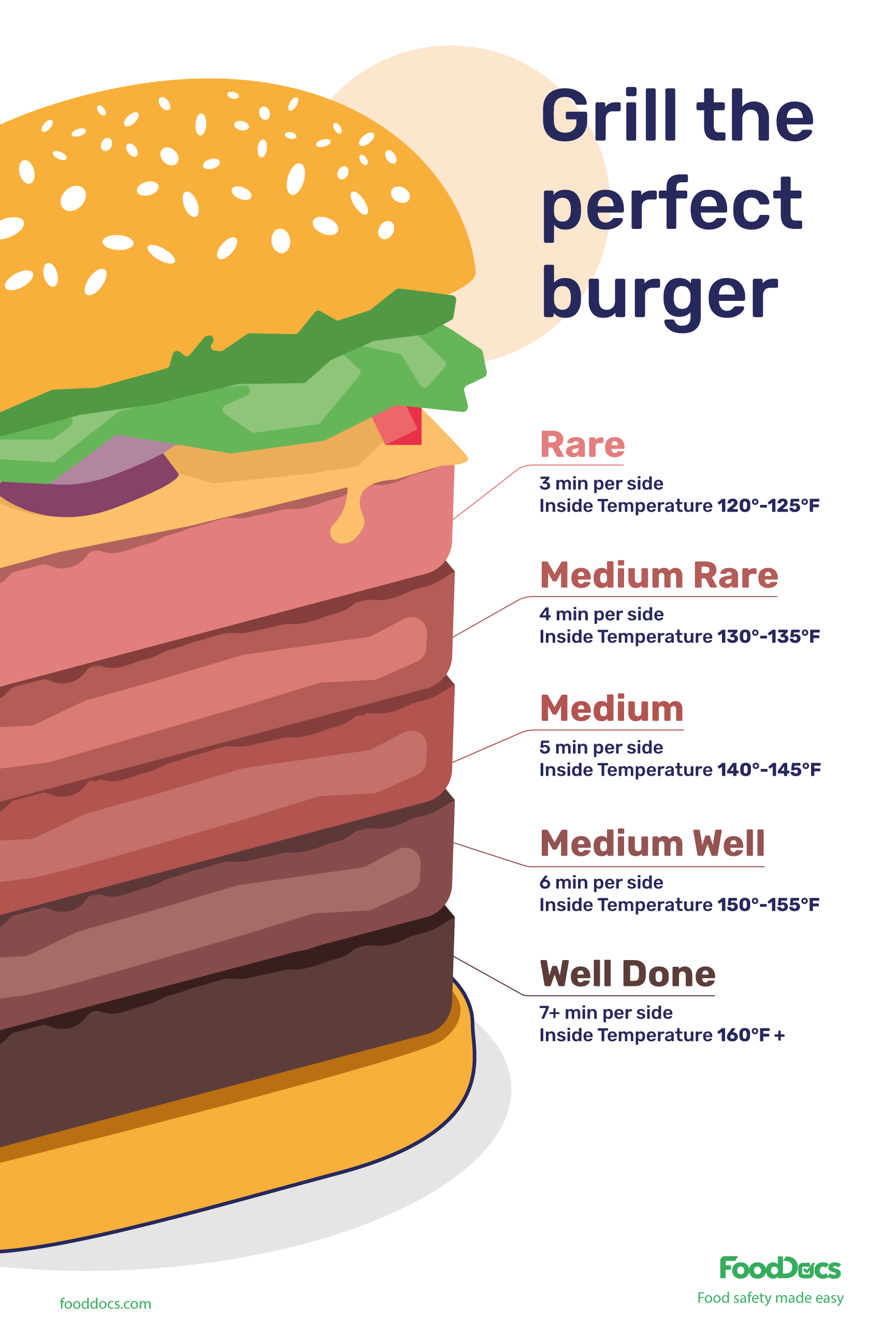
For home-cooked burgers, use 160 degrees F for ground beef, pork, lamb, or veal burgers and 165 degrees F for chicken or turkey burgers. Color is not a reliable safety test for ground meat, so check the center of the patty with an instant-read thermometer.
Burger Cooking Chart
| Burger type | Safe internal temperature | Where to check |
|---|---|---|
| Ground beef burger | 160 degrees F | Center of the thickest patty |
| Ground pork, lamb, veal, or mixed-meat burger | 160 degrees F | Center of the thickest patty |
| Turkey burger | 165 degrees F | Center of the thickest patty |
| Chicken burger | 165 degrees F | Center of the thickest patty |
| Plant-based burger | Follow the package directions | Center, especially if frozen or thick |
Why Ground Meat Needs A Higher Temperature Than Steak
A steak mainly has surface exposure before cooking, while ground meat is mixed throughout. That means bacteria from the surface can be moved into the center of a burger patty. This is why a burger chart should not use steak doneness temperatures as the main home-safety guide.
How To Check A Burger Correctly
- Use a clean instant-read thermometer.
- Insert the probe into the thickest part of the patty.
- For thin patties, insert from the side so the tip reaches the center.
- Check more than one patty if thickness varies.
- Clean the thermometer after touching undercooked meat.
Timing Guide By Thickness
Cooking time changes with grill heat, pan heat, patty thickness, fat level, starting temperature, and whether the patty is fresh or frozen. Use this as a planning guide, then confirm with temperature.
| Patty style | Typical approach | Final check |
|---|---|---|
| Thin smash burger | Hot griddle or skillet, short cook on each side | Center reaches the safe target for the meat type |
| Standard 1/3-pound beef burger | Medium-high heat, flip once or twice as needed | 160 degrees F in the center |
| Thick pub-style burger | Moderate heat after searing so the outside does not burn first | 160 degrees F for beef or 165 degrees F for poultry |
| Frozen burger patty | Cook from frozen if the package allows; add time | Check the center because frozen patties heat unevenly |
Common Burger Safety Mistakes
- Using color or clear juices as the only safety test.
- Putting cooked burgers back on a plate that held raw patties.
- Pressing patties hard and drying them out while still not checking the center.
- Using steak temperatures for ground beef burgers.
- Letting raw patties sit out while the grill heats for a long time.
FAQ
What temperature should a beef burger be?
For home food safety, cook a ground beef burger to 160 degrees F in the center. Use a thermometer rather than color.
What temperature should a turkey burger be?
A turkey burger should reach 165 degrees F in the center. The same 165 degrees F target applies to chicken burgers and other ground poultry.
Can a burger be pink and safe?
Color can be misleading. Some burgers can look brown before they reach a safe temperature, and some can stay pink after reaching temperature. Use the thermometer reading as the decision point.
Do burgers need to rest?
A short rest can help juices settle, but ground meat burgers should already be at their safe internal temperature before resting. Do not count on resting to fix an undercooked center.