
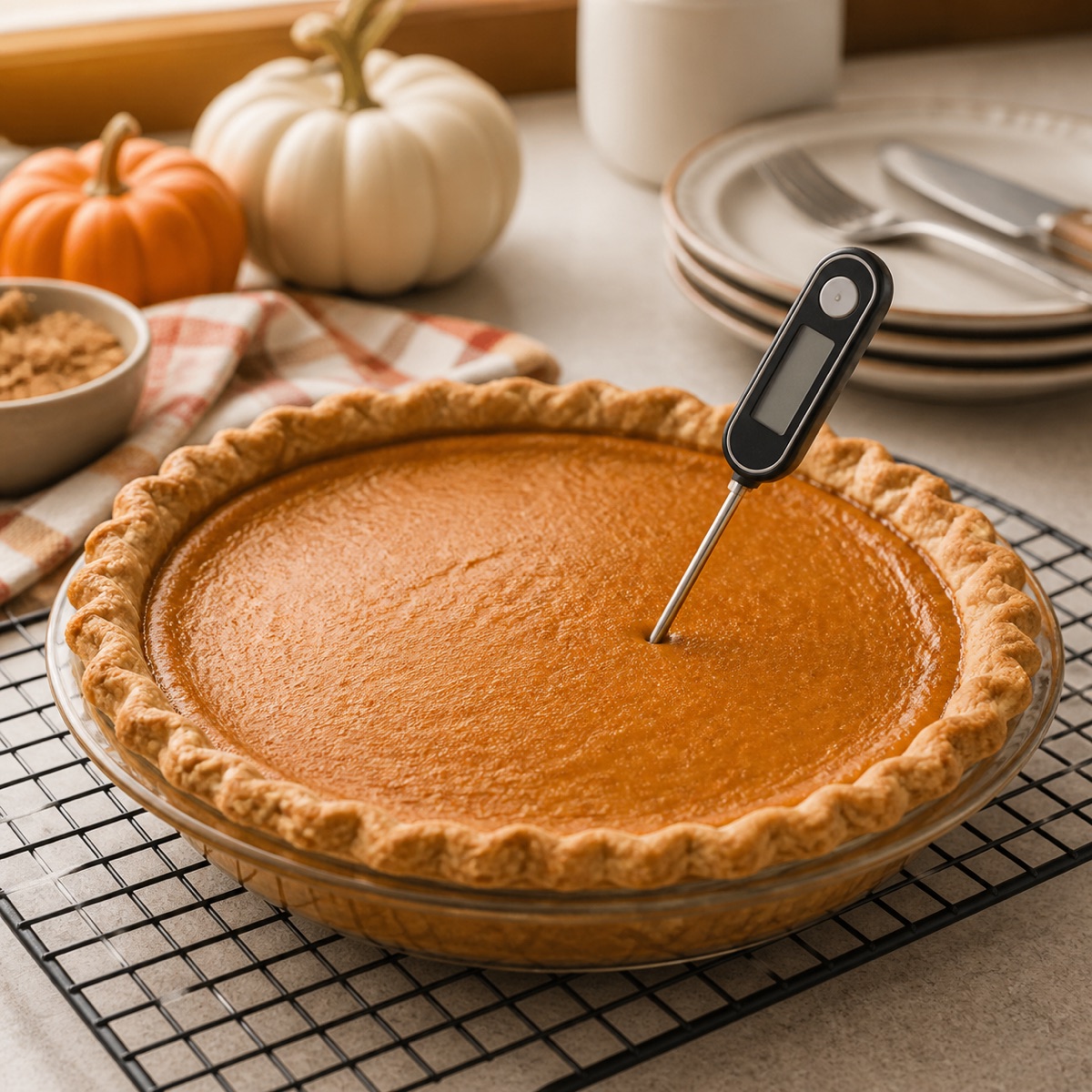
Pumpkin pie is done when the edges are set, the center still has a gentle wobble, and an instant-read thermometer inserted near the center reads about 175°F to 180°F. Do not rely on a clean knife alone: it can make the filling crack and may not catch an under-set center.
The Best Doneness Test
The most reliable test is an instant-read thermometer. Insert it into the center area of the filling without touching the pan. For a classic custard-style pumpkin pie, aim for about 175°F to 180°F. The pie will continue to firm as it cools, so pulling it while the center still has a small jiggle helps avoid a dry, cracked filling.
| Test | What Done Looks Like | How Much To Trust It |
|---|---|---|
| Thermometer | About 175°F to 180°F near the center | Best test |
| Jiggle test | Edges are set; center wobbles slightly like soft gelatin | Good backup |
| Crust color | Golden, not pale or burnt | Helpful but not enough |
| Knife test | Knife comes out mostly clean | Less ideal; can crack the pie |
How To Check A Pumpkin Pie Step By Step
- Look at the edges. The outer 1 to 2 inches should look set and slightly puffed.
- Gently nudge the pie. The center should wobble a little, not slosh like liquid.
- Use a thermometer. Check near the center of the filling. About 175°F to 180°F is the practical doneness range for a custard pie.
- Stop before it looks completely firm. A pumpkin pie that is fully firm in the oven is often overbaked by the time it cools.
- Cool it on a rack. Let the pie finish setting as it cools before slicing.
What A Done Pumpkin Pie Looks Like
A done pumpkin pie has a set outer ring, a center that moves as one soft piece, and a filling surface that looks matte rather than wet. Small bubbles near the edge can be a warning that the custard is getting too hot. If the filling has pulled away from the crust or has deep cracks, it was probably overbaked.
Can You Use The Knife Test?
You can, but it is not the best first choice. The knife test leaves a visible cut and often encourages bakers to overbake the pie until the center is too firm. A thermometer is cleaner and more consistent. If you do use a knife, insert it slightly off-center rather than directly in the middle.
Why The Center Should Still Jiggle
Pumpkin pie is a custard. Custards keep setting after they leave the oven because carryover heat continues working through the filling. A slight jiggle means the filling is set enough to cool into clean slices. A loose wave or liquid movement means it needs more time.
How Long To Cool And Store Pumpkin Pie
Cool homemade pumpkin pie at room temperature, then refrigerate it. Because pumpkin pie usually contains eggs and milk or cream, it should not sit out for long periods. Follow food-safety guidance for perishable foods and refrigerate leftovers promptly, especially if the kitchen is warm.
Troubleshooting
- Cracked top: The pie was likely overbaked or cooled too quickly.
- Watery center: It needed more baking time or the filling ratio was off.
- Burnt crust, loose filling: Shield the crust with foil and keep baking until the center sets.
- Rubbery texture: The custard was baked too long or too hot.
FAQ
Is pumpkin pie done at 165°F?
For many egg dishes, 160°F to 165°F is a safety reference point, but pumpkin pie texture usually sets better closer to the high 170s. For this page, use about 175°F to 180°F as the practical doneness target.
Should pumpkin pie be jiggly when it comes out?
Yes, slightly. The center should wobble gently as one piece, while the edges look set. It should not ripple like liquid.
Why did my pumpkin pie crack?
Cracks usually mean the filling got too hot or baked too long. Pull the pie earlier, use a thermometer, and let it cool gradually.
Can I put an underdone pumpkin pie back in the oven?
Yes, if you catch it before serving. Return it to the oven and check every 5 to 10 minutes until the center is set and the temperature target is reached.