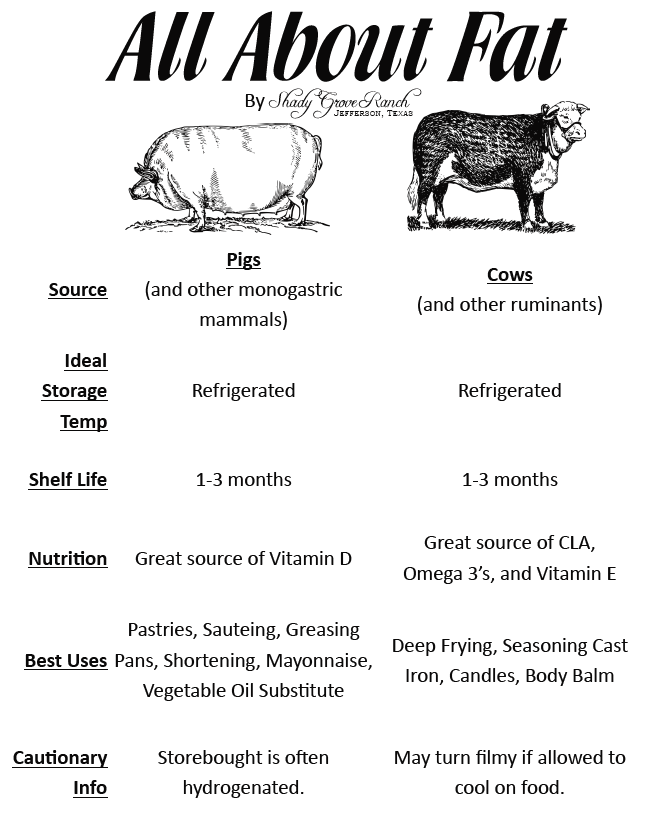
– Tallow and lard are traditional fats used in cooking.
– Tallow comes from beef fat, while lard comes from pig fat.
– Tallow is solid at room temperature, while lard has a softer texture.
– Tallow has a rich, savory flavor, while lard is more mild and neutral.
– Both fats are high in saturated fats.
– Tallow has a higher smoke point and is often used for frying.
– Lard is commonly used in baking.
– Tallow and lard can be substituted for each other in recipes, with slight variations in texture and taste.
– Both fats contain essential vitamins.
– A tablespoon of beef tallow and lard both contain 115 calories.
– The polyunsaturated fat content of beef tallow is 0.5 g, while lard contains 1.4 g.
– The monounsaturated fat content of beef tallow is 5.4 g, while lard contains 5.8 g.
– The saturated fat content of beef tallow is 6.4 g, while lard contains 5 g.
– Both beef tallow and lard contain 0 g of trans fat, and their total fat content is 12.8 g.
– The cholesterol content of beef tallow is 14 mg, while lard contains 12 mg.
– Beef tallow and lard should be stored in airtight containers in a cool, dark place.
– Freezing is an option for long-term storage.
– Regularly checking for signs of spoilage is important.
– The choice between beef tallow and lard depends on the desired flavor and dish being cooked.
– Beef tallow provides a stronger beefy flavor, while lard has a more neutral flavor.
– Beef tallow is recommended for dishes that require a beefy flavor, while lard is suitable for dishes involving pork or chicken.
– Beef tallow can be used as a substitute for lard, but the flavor will be different.
– Lard tends to produce a crisper texture and has a slightly milder flavor in deep frying.
– Tallow offers a distinct beefy flavor and has a higher smoke point, making it better for frying at higher temperatures.
– Beef tallow is solid, while olive oil is liquid.
– Beef tallow has a higher smoke point of 400 degrees Fahrenheit, while olive oil has a smoke point range of 350-470 degrees Fahrenheit.
– Beef tallow is saturated fat, while olive oil is monounsaturated fat.
– Beef tallow has a beefy taste, while olive oil has a grassy or neutral taste.
– Beef tallow is good for raw, low heat, and moderate heat cooking, while olive oil is good for raw, low, moderate, and high heat cooking.
– Beef tallow is not suitable for vegans, while olive oil is.
– Beef tallow comes from animal fat, while olive oil comes from plants.
– Olive oil comes in different types with varying qualities and flavors.
– Beef tallow has a higher smoke point and is suitable for high-heat cooking methods like frying and roasting.
– Olive oil is used for a variety of cooking methods and has a mild flavor.
– Beef tallow is not recommended for sweet dishes due to its taste.
– Beef tallow and olive oil can be used as substitutes for each other depending on the dish and desired flavor profile.
– Beef tallow is predominantly composed of saturated fats, while olive oil is primarily made up of monounsaturated fats.
– Olive oil is cholesterol-free and contains higher amounts of vitamin E and antioxidants compared to beef tallow.
– Beef tallow should be stored in an airtight container in a cool, dark place, while olive oil should be stored away from direct sunlight and heat sources.
– Both beef tallow and olive oil have their own unique qualities and uses.
Continue Reading