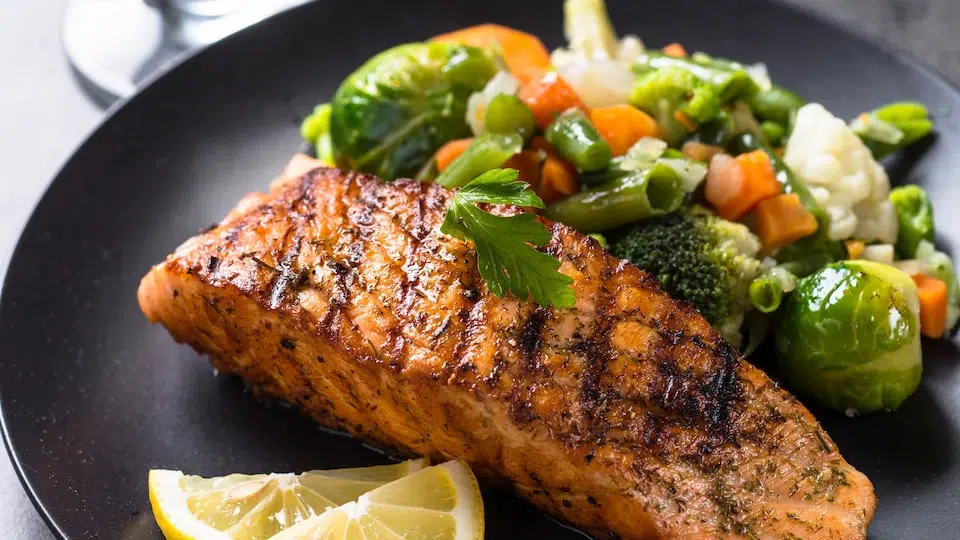
Reheating Salmon: Safe Tips for Delicious Enjoyment

– Reheating salmon can be challenging but not impossible
– Microwaving salmon dries it out and creates a fishy aroma
– Adding moisture with olive oil or lemon preserves flavor
– Reheating in the oven at 300 degrees for 15 minutes is recommended
– Covering the salmon with foil prevents drying out and burning
– Leftover salmon can be used in various recipes such as fish salad or mixed with avocado or mayo
– Fish is a popular protein, but leftover cooked fish is often thrown out due to concerns about contamination or spoilage.
– Storing cooked fish in the fridge is safe with proper precautions and procedures.
– Cooked salmon can be stored in the fridge for up to three days if it was fresh to begin with and handled properly.
– Refrigerating leftovers slows down, but does not stop, the formation of bacteria.
– Cooked salmon should be cooled to room temperature before storing to prevent mold and bacteria formation.
– Salmon should be put in the fridge within two hours of cooking to prevent bacterial growth.
– Salmon should be stored in an airtight container or wrapped in plastic wrap and aluminum foil to maintain freshness.
– The article provides steps on how to store cooked salmon and tips for reheating it. It suggests storing cooked salmon in the bottom drawer of the fridge, which is usually the coldest spot. It is important to date and label the container. Cooked salmon should be eaten or cooked again within 3 days, as after that there is a risk of bacteria causing food poisoning. To reheat leftover salmon, it is recommended to avoid using the microwave and instead cook it on low heat to prevent it from drying out. Wrapping it in foil can help achieve a more even cook. Oshēn Salmon is mentioned as a source for top-quality and fresh salmon delivered to your door, with a discount code available for ordering.

Continue Reading

How Long is Deli Cheese Good for? Essential Shelf Life Tips

– Sliced deli cheese can last 2 to 3 weeks if stored properly and immediately after purchase.
– Once opened, use cheese slices within 5 days to 1 week for best quality.
– Factors that can affect shelf life include storage temperature, packaging type, and firmness.
– Harder types of cheese last longer than softer ones.
– Sliced deli cheese should not be at room temperature for more than four hours to prevent bacterial growth.
– Refrigerated sliced deli cheese should be stored between 35 and 45 degrees Fahrenheit.
– Freezing sliced deli cheese can extend its storage life to around 6-8 months or longer.
– Freezing may affect the flavor and overall quality of the cheese.
– Discoloration, mold growth, and a strong, off-putting smell are signs that the deli cheese has gone bad.
– Proper storage methods, such as keeping the cheese in the refrigerator or freezer, can help prevent molding.
– Block cheese generally has a longer shelf life compared to sliced deli cheese.

Continue Reading

At What Temperature Would Stored Raw Chicken Become Unsafe to Use?

– The safe temperature for raw chicken is at least 40 degrees Fahrenheit
– Raw chicken should be stored in a refrigerator or freezer immediately after purchase
– Raw chicken should not sit at room temperature for more than two hours
– Always wash hands after handling raw meat
– Thawed raw chicken can be cooked and should reach an internal temperature of 165 degrees Fahrenheit
– Cooked chicken should be refrigerated below 40 degrees Fahrenheit within two hours
– Cooked chicken should be consumed within 3-4 days
– Rinsing raw poultry is not recommended as it does not remove bacteria and can spread it
– Essential points for handling chicken include refrigerating it immediately after purchase, avoiding leaving it in a hot car, and using an insulated container when transporting it.
– Raw chicken can be refrigerated in its original wrapping in the coldest part of the refrigerator for 48 hours after purchase.
– If raw chicken will not be used within 48 hours, freezing is recommended.
– Cooked, cut-up chicken should be refrigerated for two days or less, while whole cooked chicken should be refrigerated for three days or less.
– Fresh, uncooked chicken should be kept on the lowest level of the refrigerator to avoid dripping on other foods.
– Thawing methods:
1. Refrigerator thawing is the preferred method. A 4-pound entire chicken takes about 24 hours to thaw in the refrigerator, while cut-up portions need 3 to 9 hours.
2. Thawing in cold water: Place the chicken in its original wrap or a waterproof plastic bag and change the water every 30 minutes. It takes around 2 hours to thaw a 4-pound entire chicken.
3. Microwave thawing: Use the microwave on the Defrost or Medium-Low setting. Microwave for 2 minutes, then set aside for 2 minutes. Repeat if necessary. Ensure the chicken does not begin to cook.
– When cooking chicken, use an instant-read meat thermometer to test for doneness. The thickest part of the chicken (breast or thigh) should reach a safe minimum internal temperature of 165°F, according to the USDA Food Safety guidelines.
– It is important to check the “best if used by” date and look for signs of spoilage such as changes in smell, texture, and color.
– Vacuum-sealed cooked chicken can last up to two weeks in the refrigerator.
– Vacuum-sealed raw chicken should be consumed within 4-5 days.
– Bacteria multiply quickly at temperatures between 40-140 degrees Fahrenheit.
– Raw chicken should be frozen for two days to keep it fresh for nine months.

Continue Reading

The Optimal Lasagna Internal Temp: Guidelines for Perfection

– The ideal baking temperature for lasagna is between 375°F (190°C) and 400°F (204°C).
– The recommended internal temperature for lasagna is 160°F (71°C) or higher.
– To check the temperature of the lasagna, a meat thermometer should be inserted in the middle of the dish to ensure it reaches at least 160°F (71°C).
– The lasagna is considered done when the internal temperature hits 165°F (74°C), the top is golden brown, and the edges are bubbling.
– In an oven, lasagna should be baked covered with foil at 375°F (190°C) for 25-30 minutes, then uncovered and cooked for another 25-30 minutes until the internal temperature is 160°F (71°C).
– In an air fryer, lasagna should be cooked at 360°F (182°C) for 20-25 minutes, until the top is golden and the internal temperature reaches 165°F (74°C).
– In an electric roaster, lasagna should be cooked covered with foil at 375°F (190°C) for 1 hour, then uncovered and cooked for another 15-20 minutes until golden and bubbly.
– At a temperature of 350°F (175°C), lasagna should be cooked covered with foil for 45-50 minutes, then uncovered and cooked for another 15-20 minutes until golden and bubbly.
– At a temperature of 400°F (200°C), lasagna should be cooked covered for about 20-25 minutes, then uncovered and baked again.
– The article suggests letting the lasagna rest for 15-20 minutes before cutting to allow the flavors to meld and make it easier to cut and serve.
– The ideal temperature for serving lasagna is between 150°F (65°C) and 160°F (71°C).
– The internal temperature of frozen lasagna should reach at least 165°F (74°C) to ensure any harmful bacteria are destroyed.
– To reheat frozen lasagna, the article suggests oven heating at 350°F (175°C) for 25-30 minutes, medium power heating in the microwave for 5 minutes, or air frying at 350°F (175°C) for 15-20 minutes.
– The recommended internal temperature to reheat homemade lasagna is 165°F (74°C).
– Reheating can be done in the oven by preheating to 350°F (175°C), covering the lasagna with foil, and reheating for 25-30 minutes.
– It can also be reheated in the microwave using medium power for 2-3 minutes, followed by additional 1-minute increments if needed.
– Another option is to use an air fryer by preheating it to 350°F (175°C) and reheating the lasagna covered for 15-20 minutes.
– When microwaving lasagna, the internal temperature should reach 160-165 degrees Fahrenheit.
– Using a food thermometer is important to ensure the lasagna is cooked throughout and reaches a temperature of 165 degrees Fahrenheit.
– Pre-heating the oven for 20 minutes before baking helps ensure even cooking.
– The top layer of the lasagna should be golden brown.
– Check that the sauce is bubbling on the sides to verify that it is cooked.
– A toothpick or food thermometer can be used to check the temperature of the lasagna.
– Preheating the oven to the correct temperature is important to prevent uneven cooking.
– Reheating a large lasagna is not recommended as it may not reheat evenly.
– No-boil noodles and a layer of non-stick oil on foil can speed up cooking and trap moisture.
– Toothpicks can be used to hold the foil in place.
– Add the sauce to the bottom of the lasagna after placing the foil.

Continue Reading

Does Hummus Need to be Refrigerated? An Informed Guide

– Hummus needs to be refrigerated due to food safety concerns
– Ingredients in hummus, such as chickpeas, tahini, and olive oil, can spoil quickly at room temperature
– Hummus can last for a week or two at room temperature if made with fresh ingredients, but the longer it sits out, the more likely it is to develop mold or bacteria
– Commercial brands of hummus may have preservatives that extend their shelf life, so refrigeration may not be necessary for these types – Homemade hummus or brands without preservatives should be refrigerated.
– Hummus can sit out at room temperature for up to two hours before it should be refrigerated.
– Leaving hummus unrefrigerated will cause it to spoil within a few days.
– To determine if hummus has gone bad, check for brown or black color, sour or off smell, and lumpy or watery texture.
– Hummus can be stored for up to a week.
– Store hummus in an airtight container in the fridge and give it a stir before each use to maintain freshness.
– Hummus is vegan, made from chickpeas, tahini, olive oil, and lemon juice.
– Hummus does not contain dairy.
– Hummus is keto-friendly, made from low-carb and high-fiber chickpeas.
– Hummus is low FODMAP in small amounts, with one cup of chickpeas containing 1.6 grams of FODMAPs and one cup of tahini containing 6.3 grams.

Continue Reading

How Long is Chicken Good for After the Sell By Date: A Guide to Safe Consumption of Poultry

– The sell-by date on chicken is intended for retailers and is an indication of the date by which chicken should be sold for peak freshness.
– The sell-by date is not a safety date or expiration date.
– Chicken is generally good for up to 2 days past the sell-by date.
– Fresh chicken should be cooked or frozen within 1 to 2 days of purchase.
– How the raw chicken is stored will affect how long it lasts.
– The use-by date is added by some poultry producers and is typically three to five days after the chicken was packaged.
– Chicken past the sell-by date can still be safe to eat, but always check for signs of spoilage before consuming.
– According to USDA, chicken is still safe to cook and eat up to 2 days beyond the sell-by date.
– Best-before date is a voluntary date set by the producer to indicate when the quality of food products may begin to decline.
– Raw chicken typically lasts in the fridge for up to 2 days past the sell-by date.
– Cooked chicken will last 3 to 4 days in the fridge or up to 4 to 6 months in the freezer.
– Chicken that is 5 days past the sell-by date should be tossed to avoid food poisoning.
– Raw chicken should be cooked or frozen within 1 to 2 days of purchase, so cooking chicken two weeks after the sell-by date is not recommended.
– Raw chicken can be stored in the refrigerator for 1-2 days after the sell-by date.
– Chicken should be cooked or frozen within 1 to 2 days of purchase according to USDA.
– If chicken shows signs of spoilage, it is best to throw it away.
– Chicken should be used within 1-2 days after being placed in the fridge, regardless of the sell-by date.
– It’s best to cook chicken within 1-2 days after purchase for optimal freshness.
– The sell-by date on raw chicken is a guide for retailers, not consumers.
– Chicken is typically safe to consume for 1-2 days after the sell-by date if stored correctly in the refrigerator.
– It’s generally recommended to cook or freeze chicken as soon as possible after the sell-by date to ensure safety and quality.
– The sell-by date is just a guideline for retailers, so it is important to check the chicken’s color, smell, and texture.
– To keep chicken fresh, it should be stored properly.
– If it will be used within one to two days, it should be kept in the refrigerator at a temperature below 40°F.
– If it will not be used within that time, it should be frozen in airtight packaging to preserve its quality and prevent freezer burn.

Continue Reading

Can You Eat Lamb Rare? Know the Risks for Optimal Safety!

– Lamb can be eaten rare if the exterior is cooked and the surface bacteria is killed off
– Use a meat thermometer to check for doneness and aim for an internal temperature of 120-125 degrees Fahrenheit (50 degrees Celsius)
– Let the lamb rest for five minutes after cooking to reach a final internal temperature of 128-130 degrees Fahrenheit
– It is not recommended to eat rare lamb leftovers because they may have bacteria picked up during storage
– Leftover lamb should be reheated to at least medium doneness to reduce the chances of consuming bacteria
– Eating raw lamb is not advisable due to food safety concerns, although some people enjoy lamb tartare
– If making lamb tartare, it is important to use high-quality, previously frozen lamb and ensure cleanliness during preparation
– Common foodborne pathogens associated with undercooked lamb include E. Coli, Salmonella, Staphylococcus aureus, Norovirus, and Campylobacter
– Proper cooking, such as searing the lamb, helps remove bacteria from the outer surface

Continue Reading

How Long Can Almond Milk Sit Out Safely?

– Almond milk is different from cow’s milk and doesn’t go bad in the same way.
– Homemade or refrigerated almond milk should not sit out for more than two hours.
– Unopened shelf-stable almond milk can sit out until the expiration date (generally 6-12 months).
– Homemade almond milk can be kept fresh for about 7 days in the refrigerator.
– Store-bought refrigerated almond milk is made the same way as homemade but with added ingredients to prolong shelf life.
– Almond milk manufacturers use pasteurization to kill bacteria, allowing the milk to stay fresh for weeks.
– After opening refrigerated almond milk, it should last about seven days.
– Almond milk should not sit out at room temperature for more than two hours.
– Unopened shelf-stable almond milk can sit out longer than opened almond milk.
– Shelf-stable almond milk can last several months or up to a year without refrigeration.
– Opened almond milk (regardless of type) can last about 7 days after opening.
– If refrigerated or opened shelf-stable almond milk is left out for more than two hours, it is recommended to throw it away to avoid potential food poisoning symptoms.
– Leaving almond milk out, even for a short time, can lead to the growth of mold and bacteria, increasing the risk of food poisoning.

Continue Reading