Can You Freeze Gravy? Here’s Everything You Need

– The article discusses whether leftover gravy can be frozen.
– Gravy is made from leftover juices of cooked meat, along with broth, cream/milk, butter, and spices.
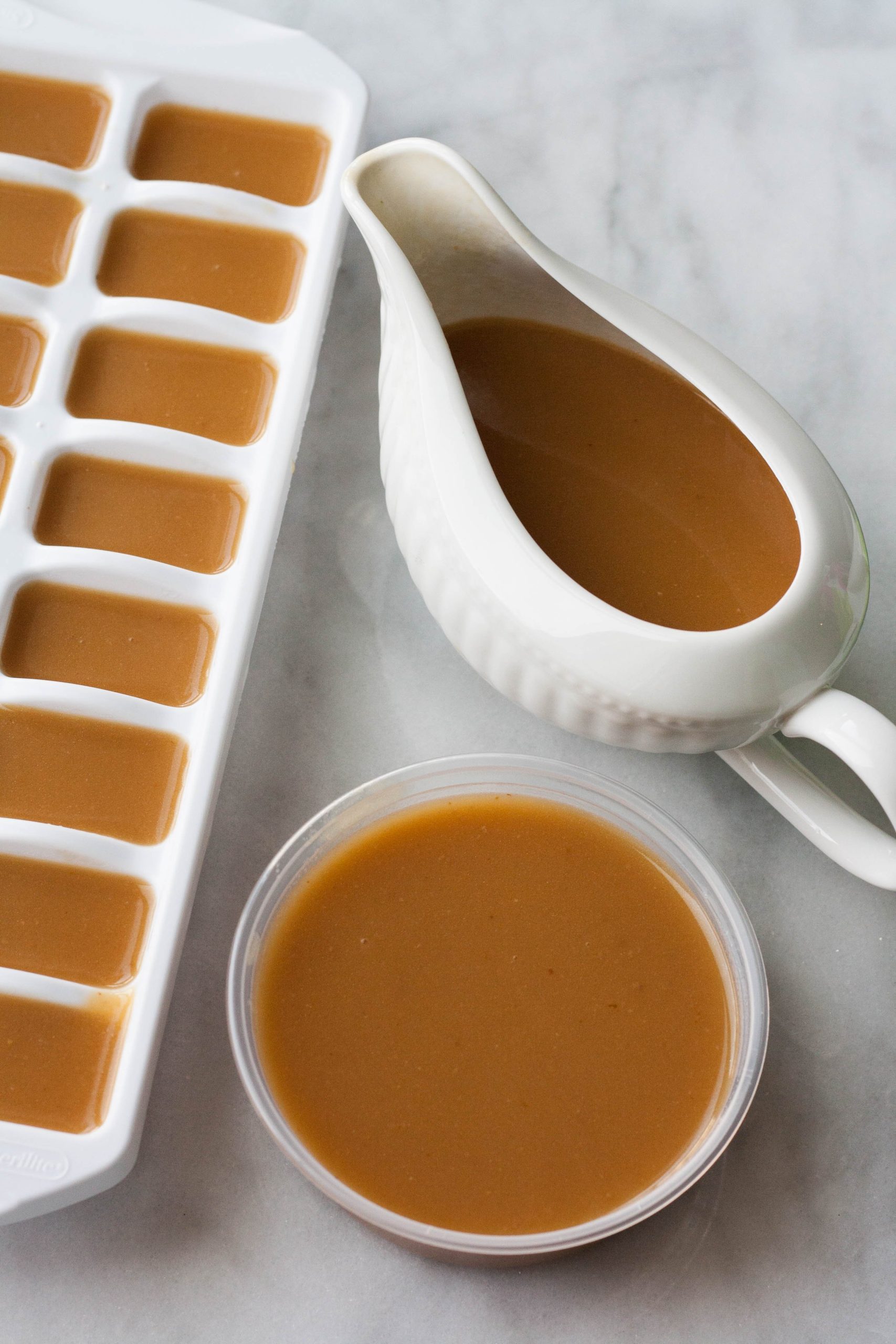
– Gravy can be frozen in air-tight containers or freezer bags and will last for up to six months.
– If the gravy contains dairy, it is not recommended to freeze it as the texture will change and it will separate when thawed.
– Gravy can also be refrigerated for up to four days in an airtight container.
– It is important to cool down the gravy within two hours of cooking to prevent bacteria growth.
– If the gravy smells rotten or sour, it should be thrown out.
– Look for signs of mold or any fuzzy or abnormal appearance to determine if the gravy has gone bad.
– Premade gravy dry mix can be stored in a sealed container or plastic bag.
– Gravy is made from the leftover juices of cooked meats, typically turkey or beef, with additional broth, cream or milk, butter, and spices added for flavor.
– Traditional gravy recipes use all-purpose or wheat flours as thickeners, but cornstarch can be used as a gluten-free alternative.
– Dairy-based gravies should not be frozen as they will separate and have a gritty texture when thawed.
– Spoiled gravy can be identified by a rotten or sour smell, mold growth, or abnormal texture.
– Dry gravy mixes can be stored in sealed containers or plastic bags.


Continue Reading

Are Body Armors Good for You? The Surprising Facts Revealed!

Body Armor is a company that produces hydrating sports drinks without artificial ingredients, established in 2011 by Mike Repole. They offer four main products: Body Armor Sports Drink, LYTE Sports Drink, EDGE Sports Drink, and Body Armor SportWater. Body Armor LYTE has the same ingredients as Body Armor Sports Drink but with no added sugar and only 20 calories per bottle. EDGE contains added caffeine for an energy boost. SportWater is made from reverse osmosis water, has a performance pH of 9+, and contains electrolytes. In 2021, The Coca-Cola Company acquired Body Armor.

Continue Reading

The Optimal Lasagna Internal Temp: Guidelines for Perfection

– The ideal baking temperature for lasagna is between 375°F (190°C) and 400°F (204°C).
– The recommended internal temperature for lasagna is 160°F (71°C) or higher.
– To check the temperature of the lasagna, a meat thermometer should be inserted in the middle of the dish to ensure it reaches at least 160°F (71°C).
– The lasagna is considered done when the internal temperature hits 165°F (74°C), the top is golden brown, and the edges are bubbling.
– In an oven, lasagna should be baked covered with foil at 375°F (190°C) for 25-30 minutes, then uncovered and cooked for another 25-30 minutes until the internal temperature is 160°F (71°C).
– In an air fryer, lasagna should be cooked at 360°F (182°C) for 20-25 minutes, until the top is golden and the internal temperature reaches 165°F (74°C).
– In an electric roaster, lasagna should be cooked covered with foil at 375°F (190°C) for 1 hour, then uncovered and cooked for another 15-20 minutes until golden and bubbly.
– At a temperature of 350°F (175°C), lasagna should be cooked covered with foil for 45-50 minutes, then uncovered and cooked for another 15-20 minutes until golden and bubbly.
– At a temperature of 400°F (200°C), lasagna should be cooked covered for about 20-25 minutes, then uncovered and baked again.
– The article suggests letting the lasagna rest for 15-20 minutes before cutting to allow the flavors to meld and make it easier to cut and serve.
– The ideal temperature for serving lasagna is between 150°F (65°C) and 160°F (71°C).
– The internal temperature of frozen lasagna should reach at least 165°F (74°C) to ensure any harmful bacteria are destroyed.
– To reheat frozen lasagna, the article suggests oven heating at 350°F (175°C) for 25-30 minutes, medium power heating in the microwave for 5 minutes, or air frying at 350°F (175°C) for 15-20 minutes.
– The recommended internal temperature to reheat homemade lasagna is 165°F (74°C).
– Reheating can be done in the oven by preheating to 350°F (175°C), covering the lasagna with foil, and reheating for 25-30 minutes.
– It can also be reheated in the microwave using medium power for 2-3 minutes, followed by additional 1-minute increments if needed.
– Another option is to use an air fryer by preheating it to 350°F (175°C) and reheating the lasagna covered for 15-20 minutes.
– When microwaving lasagna, the internal temperature should reach 160-165 degrees Fahrenheit.
– Using a food thermometer is important to ensure the lasagna is cooked throughout and reaches a temperature of 165 degrees Fahrenheit.
– Pre-heating the oven for 20 minutes before baking helps ensure even cooking.
– The top layer of the lasagna should be golden brown.
– Check that the sauce is bubbling on the sides to verify that it is cooked.
– A toothpick or food thermometer can be used to check the temperature of the lasagna.
– Preheating the oven to the correct temperature is important to prevent uneven cooking.
– Reheating a large lasagna is not recommended as it may not reheat evenly.
– No-boil noodles and a layer of non-stick oil on foil can speed up cooking and trap moisture.
– Toothpicks can be used to hold the foil in place.
– Add the sauce to the bottom of the lasagna after placing the foil.

Continue Reading

Discover the Perfect PlantBased Replacement for Sesame Oil

– Tahini: Substitute ¾ tablespoon of tahini for 1 tablespoon of sesame oil. For smaller amounts, use ¾ teaspoon of tahini for each teaspoon of sesame oil.

– Perilla Oil: Use perilla oil as a replacement for dark or toasted sesame oil for a similar flavor profile. Look for perilla oil in specialty ethnic stores or Asian markets.

– Toasted Sesame Seeds: Use toasted sesame seeds as a flavor replacement when the binding function of sesame oil is not necessary. Lightly toast the sesame seeds and sprinkle them into stir-fried recipes or use as a garnish.

– Walnut Oil: Substitute walnut oil for a mild nutty flavor. It is best used in marinades, uncooked sauce, salad dressings, and as a flavor addition to finished dishes.

– Olive Oil: Extra virgin olive oil can be used as a substitute for light or untoasted sesame oil. It has a similar flavor profile and consistency. No specific smoke point mentioned.

– Avocado Oil: Avocado oil can be used as a substitute for sesame oil to match richness and texture, although it doesn’t add the same flavor.

– Peanut Oil: Peanut oil is a suitable choice for wok-frying and stir-fry recipes, as it has a high smoke point and a nutty flavor.

– Toasted Peanuts: Toasted or plain, roughly chopped peanuts can be added to recipes as a last-minute addition or garnish to enhance flavor.

– Almond Oil: Almond oil has its own distinctive flavor and is suitable for wok-frying, stir-frying, and dressings.

– Butter or Ghee: Butter or ghee can be stirred into dishes at the end of the cooking process to add a rich, creamy texture and can also be browned for a deeper flavor.

Please note that the list has been modified to eliminate any duplication and is tailored specifically to the keyword “replacement for sesame oil”.

Continue Reading

Do raisins go bad? The truth revealed!

List:

– Raisins can go bad under certain conditions, such as if they have a strange smell or visible mold.
– The quality of raisins will decline over time and they may also dry out.
– Unopened raisins can stay fresh for up to three months after the “best by” date.
– Opened packages of raisins can be enjoyed for up to six months after opening.
– Raisins typically have a shelf life of 6 to 12 months, but if unopened and stored in the fridge, they may last up to 2 years.
– Opened raisins can last up to a year when stored in the fridge.
– Unopened raisins in an airtight container last longer.
– Frozen raisins have an even longer shelf life.
– Organic raisins have better flavor but don’t last as long.
– Signs that raisins may be turning bad include visible mold, fungus, or any kind of growth on the raisins.
– Checking for mold growth, changes in color or scent can help determine if raisins have gone bad.
– Discard any raisins that show signs of being bad.

Continue Reading